
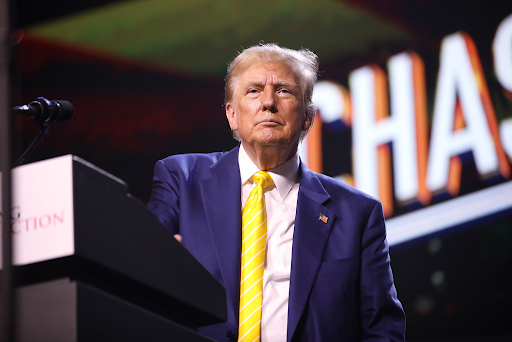
President Trump on Saturday offered a simple and direct justification for his new 15% global tariff: the United States has been “ripped off” by foreign nations for decades, and his presidency is the first to finally do something about it. The announcement, made on Truth Social, came hours after the Supreme Court struck down his previous tariff mechanism in a 6-3 ruling.
The new tariff draws on Section 122 of the Trade Act of 1974, allowing tariffs of up to 15% for 150 days before congressional authorization is needed. Trump described the provision as legally valid and immediately effective. His administration plans to use the 150-day window to build a permanent, court-resistant tariff framework that will outlast the current legal controversy.
Foreign governments challenged Trump’s narrative. Germany’s Chancellor Merz said that tariffs “harm everyone,” dismissing the idea that the United States has been uniquely victimized in global trade. He announced plans to fly to Washington with a coordinated European response and warned that the ongoing uncertainty was acting as poison for businesses across the Atlantic. France’s Macron echoed the call for reciprocal, rules-based trade.
Domestically, Trump’s response to the Supreme Court ruling reignited a fierce political debate. He called the decision “ridiculous” and attacked justices personally, describing his own nominees Barrett and Gorsuch as “an embarrassment” and claiming the court lacked patriotism. He praised dissenters Kavanaugh, Thomas, and Alito and expressed personal shame at the ruling’s outcome.
The $130 billion in tariffs collected under the now-invalidated IEEPA framework was absorbed approximately 90% by American businesses and consumers. The new 15% rate will deepen that burden, even with exemptions for critical minerals, metals, pharmaceuticals, and USMCA-compliant imports. The UK faces fresh anxiety as its 10% arrangement is effectively replaced by the new universal baseline.